So … I’ve said I’m going to race a yacht around the world for a year, and talk about “Clipper” … but what exactly is The Clipper Race?
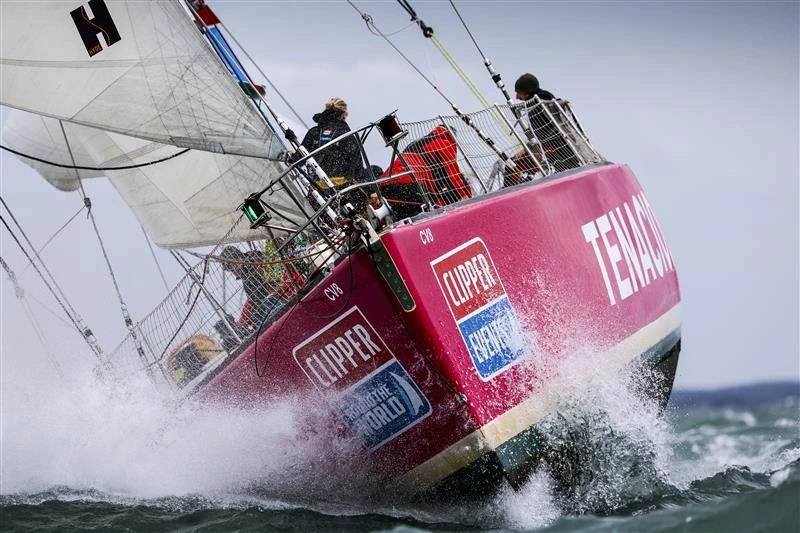
The 2025 – 26 Clipper Round The World Yacht Race
The Clipper Race is a competitive, bi-annual sailing race for novice / amateur sailors (technically you don’t have to have any prior sailing experience)
- 11 yachts
- Clipper 70s – specially designed 70 foot Ocean Racing Yachts
- Crews of c. 20 participants (plus professional Skipper and First Mate)
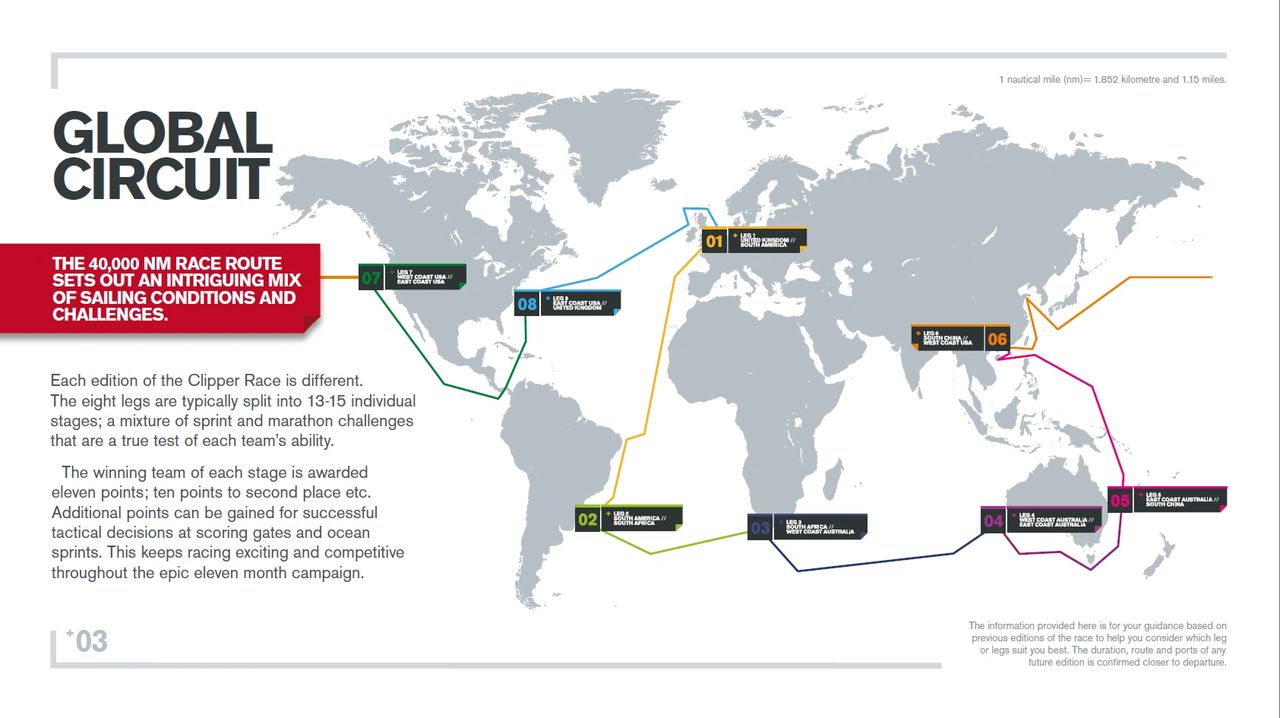
- Total of c. 40,000 nautical miles (c. 75,000 km)
- Eight ocean crossing legs (incorporating 13 – 15 races) of five to eight weeks duration
- Approximately 11 months racing (plus 4 weeks of training before the start)
- Open to anyone over 18 years old
- For single legs, multiple legs or circumnavigation
- Up to 40% of participants have no prior sailing experience
- Circumnavigators make up c. 40-50% of participants
- 55 different nationalities in 2023 – 24 edition
- Potentially 600 – 700 participants – over 5,000 participated since The Clipper Race started
- Approximately 65 / 35 male / female ratio
- The Race is in its 14th Edition
- Scheduled to start in August 2025
- Returning in July 2026
- The next Clipper Race (15th edition) will be 2027 – 28
Four separate weeks of training
The Clipper Race team have refined their training over previous editions and each crew member, whether single leg or circumnavigator, is required to complete four individual weeks of specialised training, including a safety assessment at the end of Week 1. More on these in 2025 when training restarts around February / March:
- Level 1: Crewing Skills – Emphasis on safety and developing competency
- Level 2: Offshore Sailing and Life Onboard – Getting used to “living life at an angle”!
- Level 3: Asymmetric Spinnaker Training and Racing Techniques – Embedding technical race skills and developing confidence
- Level 4: Team Tactics and Offshore Fleet Racing – Sailing with your skipper and team members following crew allocation and practice races against other teams
Eight Ocean Crossing Legs
Assuming all goes well with training and I start the race in August 2025, I’ll try to post a little content on the upcoming leg and after arriving safely in port (and hopefully getting some rest before prepping for the next leg!) some content and observations from the leg just completed.
The eight legs (which may be subject to change) are:
- Leg 1: The Atlantic Trade Winds (UK to South America) – c. 6,250 nm
- Leg 2: The South Atlantic Challenge (South America to South Africa) – c. 3,600 nm
- Leg 3: The Roaring Forties (South Africa to West Coast Australia) – c. 4,800 nm
- Leg 4: Australian Coast-to-Coast (West Coast Australia to East Coast Australia) – c. 3,400 nm
- Leg 5: The Asia-Pacific Challenge (East Coast Australia to South China) – c. 5,800 nm
- Leg 6: The Might North Pacific (South China to West Coast USA) – c. 6,900 nm
- Leg 7: Americas Coast-to-Coast (West Coast USA to East Coast USA) – c. 6,200 nm
- Leg 8: The Atlantic Homecoming (East USA to UK) – c. 3,900 nm
A little history …
In 1968-1969, Sir Robin Knox-Johnston became the first person to sail solo, non-stop around the world on his yacht Suhaili, winning the Sunday Times Gloden Globe Race having circumnavigated the globe in 312 days.
An arduous challenge, with just nine starting participants, the race led to a number retiring or conceding and also tragically led to the death of Donald Crowhurst by apparent suicide. Knox-Johnston later donated £5,000 of prize money to support Crowhurst’s family.
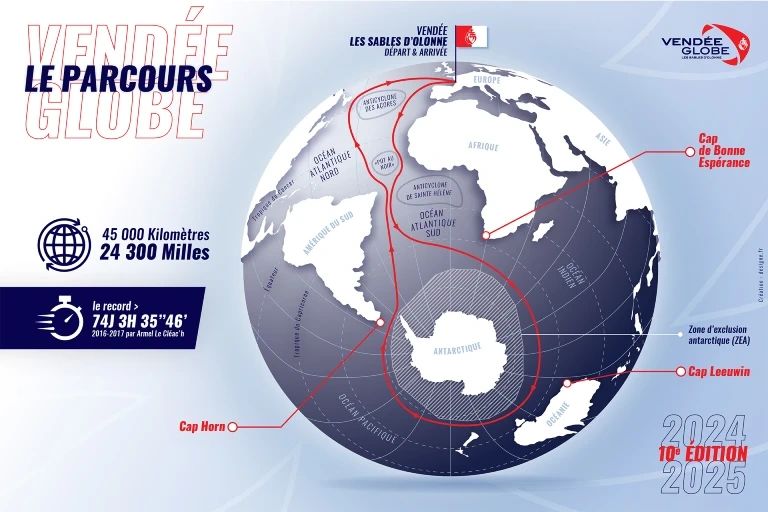
The competition inspired a number of future race challenges including the Vendée Globe which now takes place every four years on the incredible IMOCA 60 yachts and incidentally is currently underway in its 10th edition, having just started on 10 November 2024. This is a slightly shorter (and faster) race at c. 24,000 nautical miles running from Les Sables-d’Olonne in France, down toward Cape Horn, round Antarctica, past Cape of Good Hope and back to the starting point. The best time achieved so far is 74 days 3 hours and 35 minutes, by Armel Le Cléac’h in 2016!
In the 1990’s Knox-Johnston conceived of The Clipper Race as an opportunity for amateur sailors to circumnavigate the globe, and launched the first race in 1996 with a fleet of bespoke 60 foot yachts. The 2025-26 Round The World Race will be the 14th edition, on a fleet of 11 Clipper 70s – the largest, matched fleet of ocean racing yachts!
The “Clipper” name references the tea clippers of the 1800’s and the informal races back from China to London, including The Great Tea Race of 1866!
For more background: www.clipperroundtheworld.com/
Enjoyed this post? Never miss out on future posts by following me!

