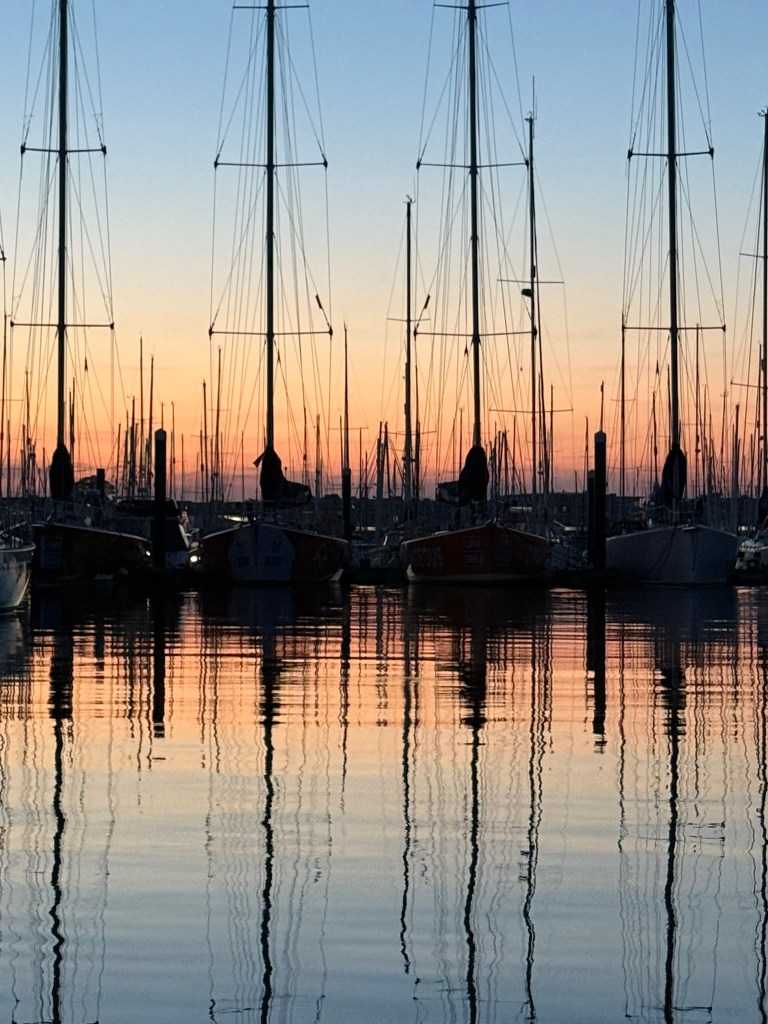
Clipper Race: Level 2 Training: Offshore Sailing and Life Onboard
After leaving my house behind in April, I’ve had a busy few months with completion of my training, and a lot of travel with my Defender (now affectionately known as Blackbird or just the Lil’ Beast …) so I’m now playing a bit of catch-up on updates!
It’s also now exaclty 3 weeks until the Race Start and I’m heading down to Gosport tomorrow to start helping with the prep onboard my boat … Team Warrant / CV29! I’ll try to post something about the crew allocation event as well)
I undertook my Level 2 and Level 3 training back-to-back at the end of April, so will cover L2 now and add L3 another time.
L2 focuses on building on the basing crewing skills and seamanship from L1, and applying that to a longer, offshore passage.
It is designed to give the crew a taster of the non-stop sailing required for our ocean passages … it introduces the watch system and the crew have to adapt to the requirements of sailing for 3 or 4 days continuously.
I’ve had the privilege of some longer passages in the past, but only a couple of days, and some night sailing … which, of course, introduces its own challenges … and have experienced the watch system before, but for many this would be a totally new experience.

With watches that might be 3 sets of 4 hours over night and two sets of 6 hours during the day … with wake ups, meals and handovers interspersed … it is pretty relentless, with very little personal time and broken sleep (albeit with the potential for 10-11 hours sleep per day overall).
This really is only a brief taste of what a leg will be like, but an important one for race crew to experience … although you’re really only just getting into the rhythm by the end of the training!
During the time at sea, it’s quite likely that you will have covered 3-400 NM … depending on the weather conditions … adding both distance and night hours to your log. We covered about 300 NM, heading down towards Plymouth and back.
Level 2 Course Content

It’s not just the sailing though, there still more to learn about aspects like collision regulations (COLREGS), wind systems and meteorology and sail patterns and trim etc. and the week started off with our RYA Sea Survival Course.
RYA Sea Survival Course
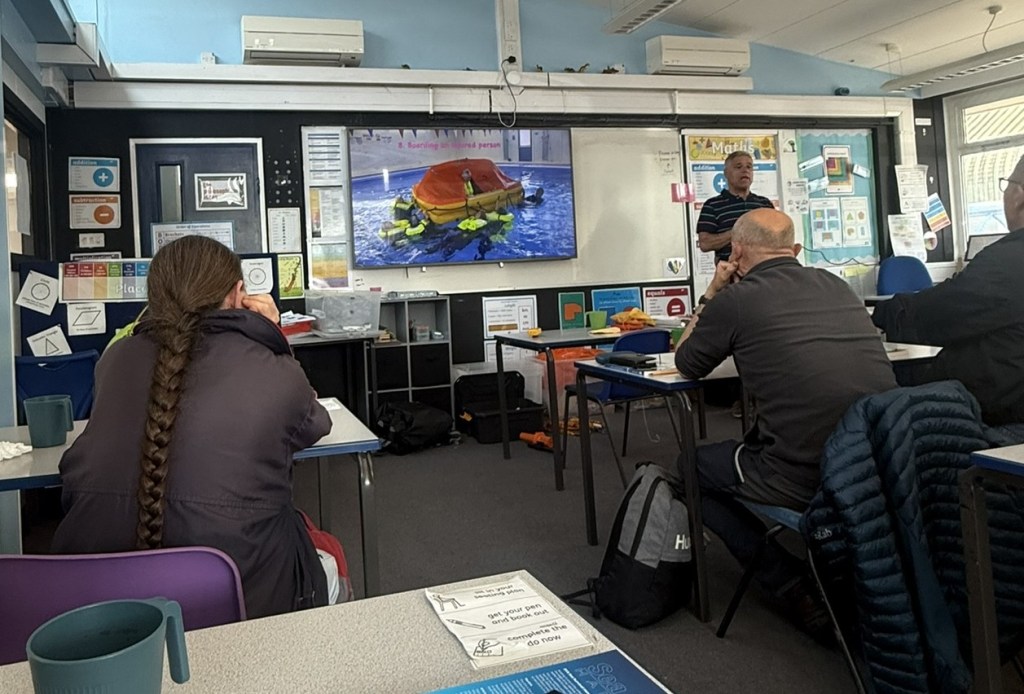
Level 2 starts with an RYA Sea Survival course … we are after all going to be offshore, so this is a fundamental knowledge requirement.
The majority of the sea survival course is classroom based, but there is also a pool session of up to 2 hours, with the practical application of our learnings … just in case we ever find ourselves in such an emergency situation.
In general, the guidance is that … in an emergency … you stay with the yacht for as long as possible.
There is a phrase used of “stepping up into a liferaft” … but it can often be misinterpreted (and potentially dangerous).
You don’t literally need to wait until the boat is about to sink beneath the surface to “step up” … but you do need to be highly confident that sinking is inevitable, or that there is an unmanageable threat to life on board e.g. an uncontrollable fire that requires you to abandon your vessel.
The Clipper 70s carry three 12-person liferafts in the race, providing cover for crews that could number as many as 22, plus some redundancy in case there is an issue with one of the liferafts.
We also have grab bags to take with us, as well as basic kit in the liferafts already, and a few items to be taken from the boat which are likely to include:
- TPA suits (Thermal Protective Aids)
- EPIRBs (Emergency Position Indicating and Radio Beacons)
- PLBs (Personal Locator Beacons) … on Clipper, these are integrated into our life jackets and have AIS (Automatic Identification System) functionality
- Boat SART (Search and Rescue Transponder)
- Flares and emergency torches
- Handheld VHF
- Rations and medicines, including seasickness etc.
- Key documents – logbooks, passports, charts etc.
Onboard the yacht, there should be a map, or a diagram … often in the nav station … which provides the key locations of various equipment on board (emergency and non-emergency) and it is well worth familiarising yourself with this.
RYA Sea Survival Course Content

The sea survival course covers:
- Principles of survival
- Modern lifesaving equipment
- Medical aspects to sea survival
- Location and recovery
- Practical
Without trying to cover the full course content, I’ll pick on some of the practical elements associated with abandoning ship:
Lifejacket deployment
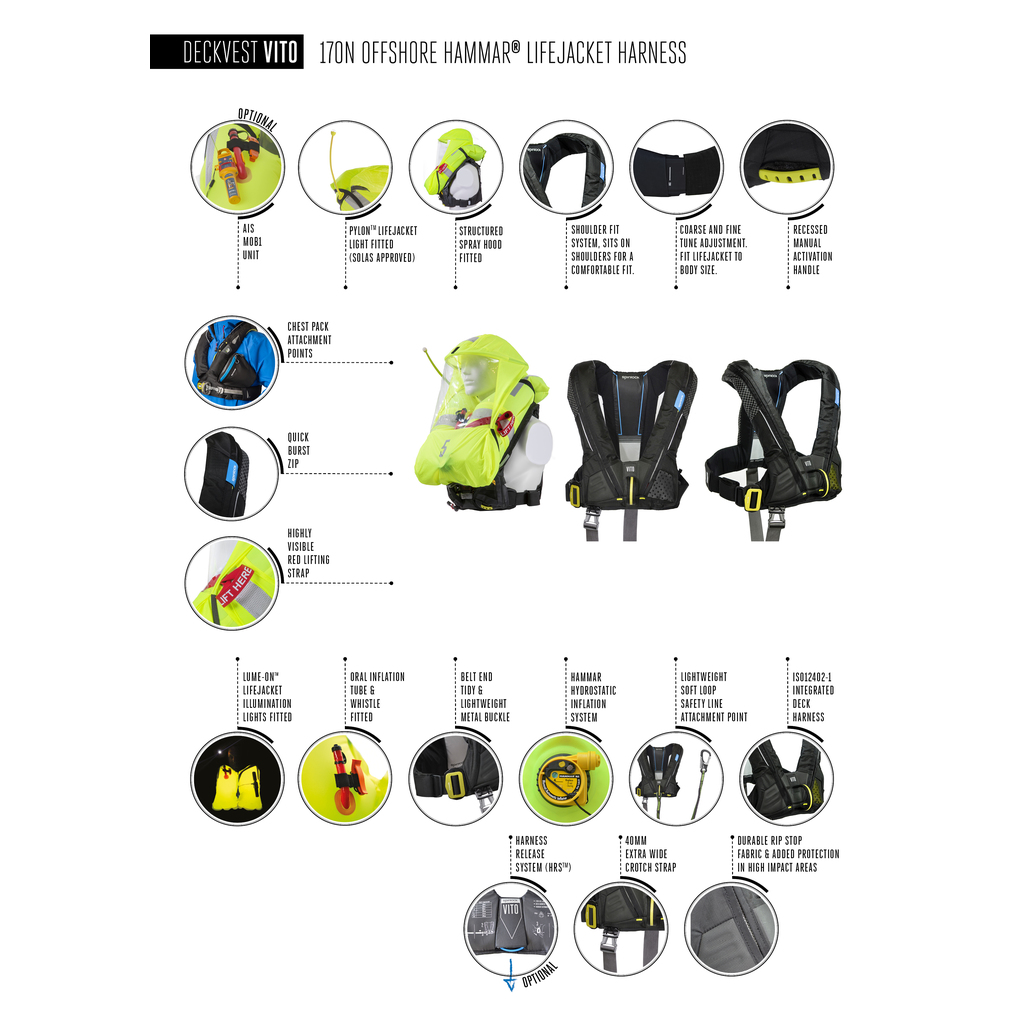
- On entering the water, make sure the life jacket is deployed. There are 3 ways this can be achieved:
- Automatic: A hydrostatic unit triggers a CO2 canister on immersion in the water
- Manual: A pull handle on the left hip should activate the canister if the automatic unit has failed
- Manual: There is a colour coded section of zip … a breakaway … usually near the left shoulder that allows you to open the jacket and an inflator tube usually on the chest on the right (also where the PLB will be located)
- Once the lifejacket is deployed, it’s important to get the spray hood on quickly by reaching over the left shoulder and pulling it over the front of the air bladders … mitigating the risk of water inhalation and drowning
- Failing this, build a bridge with your hands over your nose and mouth to provide a temporary shield
- Check the PLB has activated and the aerial extended
- A light should signal the automatic activation, but there is also a manual activation
- The aerial is a thin metal strip which unrolls to about 8/9 inches and is put through a hole in the sprayhood … it’s important to confirm this has deployed
Entering the liferaft
It’s then time to get into the liferaft as quickly as possible!
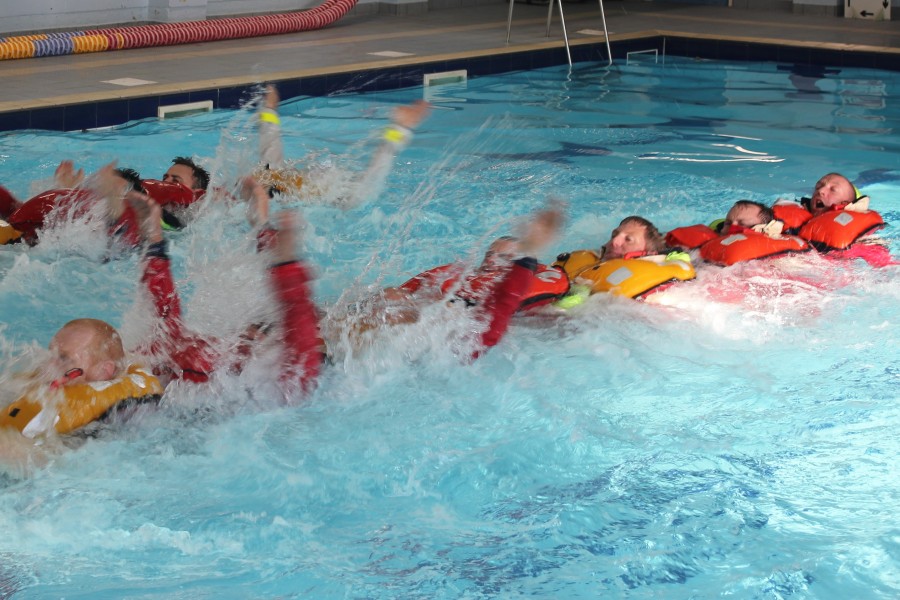
- Assuming you are very close to your other crewmates in the water, you can link up and swim as a “crocodile” … in essence you lock your legs around one person … and someone else does the same to you … and then you all swim backwards together!
- Usually, it’s best for one of the strongest crew to be at the “head” as they can then enter the liferaft first and help others in … it’s not easy to get in … and we were doing it in a warm swimming pool with no waves …
It’s quite possible that the liferaft itself has deployed upside down, and needs to be righted before entering.
By locating the gas canister on the bottom of the raft, which should be at water level rather than in the air (due to the extra weight) a pull strap helps you “walk up” the edge of the liferaft to flip it back.
It’s not that different to righting a capsized dinghy … although it is quite likely you will end up underneath the liferaft and need to swim back out to the edge.

Once righted, there are drogue pouches on the base which fill with water and act as stabilising anchors.
Entering the liferaft involves reaching up and over to another webbing ladder on the inside and getting your upper body weight up and over the lip as quickly as possible.
You then pretty much slide in with your legs up in the air … it’s not graceful, but it gets the job done!
As part of the RYA Sea Survival course, we are all expected to do this on our own. Even though the training conditions might not be close to the real weather, doing it once or twice builds some familiarity that hopefully would mitigate some of the panic that might occur in a real emergency situation.
Knowing and experiencing the process has a lot of value …
We also learnt about:
- the impact of shock e.g. cold-water shock … an involuntary response resulting in uncontrolled hyperventilation, and which can take a couple of minutes to adapt to an regain breathing control
- Adopting the HELP or Heat Escape Lessening Posture … tucking knees up to your chest and locking into your arms, as well as minimising physical exertion which can draw heat away from your core … blood flowing into your limbs, combined with the cold temperature can turn them into anchors and contribute to mental confusion
- On board the raft is a desalination pump, and a rain water system to help keep people hydrated, and there will be rations
- Rations are to be allocated and eaten in front of everyone to avoid potential loss, and / or resentment or suspicion of unfair treatment
- High protein foods are best avoided … this includes fish, unless there is a plentiful supply of water
- Apparently digesting protein rich food requires more water than the food itself provides, contributing to dehydration … something I personally never knew!
While the practical course is a novel, and somewhat fun experience in itself, it’s important to remember that in a real situation the weather and sea state conditions, the threat of danger on the yacht and potential associated time pressure, the fear and panic of crew members and cold-water shock would make the whole process significantly more challenging.
It’s important to learn the process and refresh your memory occasionally to be ready for the time you might have to apply it.
Passage sailing and watch systems
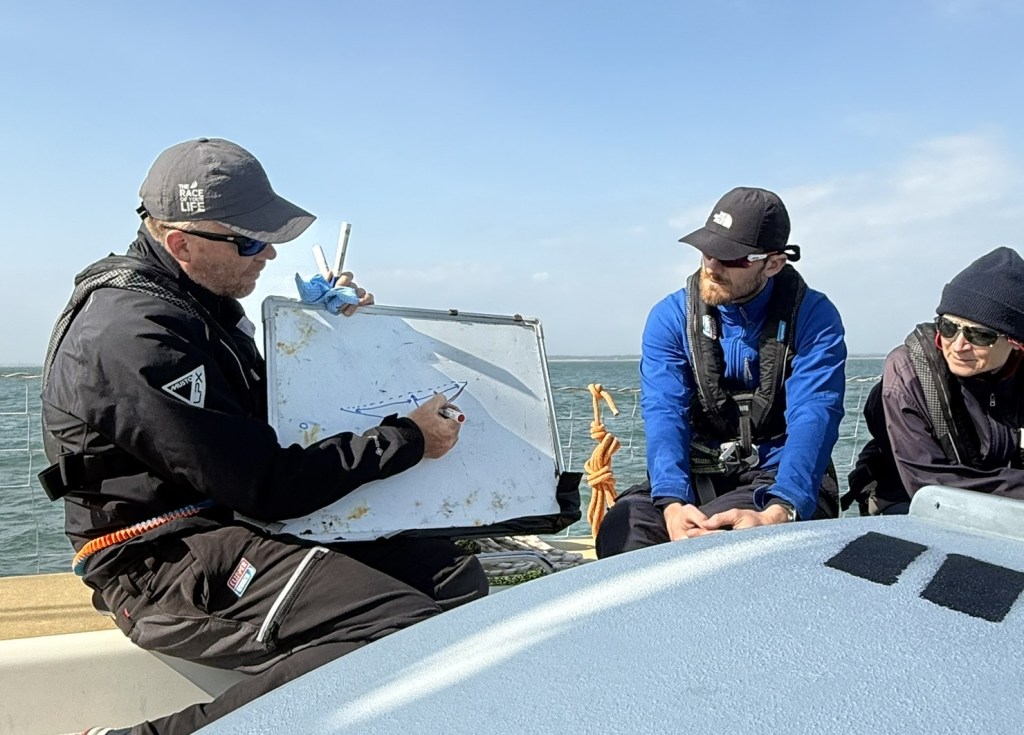
We had the privilege to sail with Al Dickson and Jade Golder for our Level 2 Training. Jade is also a former race participant … a circumnavigator … and brought a wealth of experience and insight from her own race.
Once on board, we were again allocated to watches (Port and Starboard) and would be sailing with either Al or Jade during those watches.
Setting off early evening the watch system started with 3x 4hour watches:
- 2000 to Midnight
- Midnight to 0400
- 0400 to 0800
During the day the pattern switches to 6-hour watches:
- 0800 to 1400
- 1400 to 2000
In the watch transitions, meals are likely taken at 0800, 1400 and 2000. The current watch mothers usually prepare the meal for the incoming watch so they can be on deck on time for handover, and the current / outgoing watch then eats after the handover.
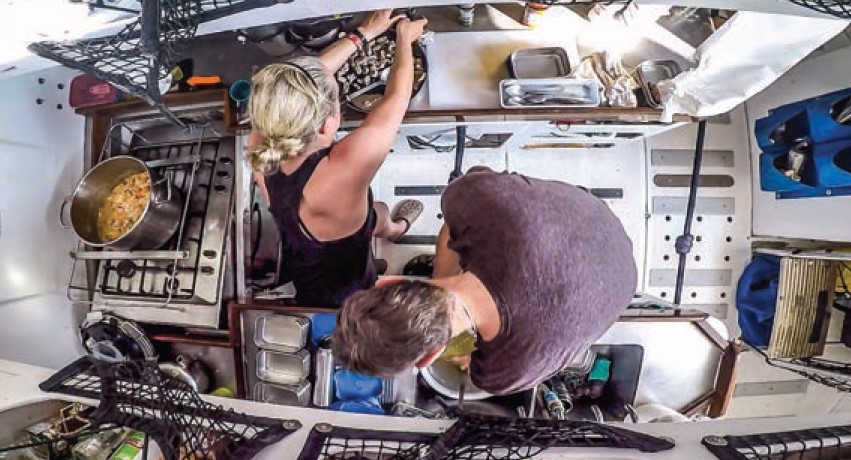
We are woken about 25 minutes before watch start, and should be on deck 5 minutes before the handover ready for a briefing and transfer of standing orders.
Be on time … the current watch will be less than impressed if they are on deck longer than need to be and this can start to have a negative impact!
I found that preparing my kit for the next watch when I came off my current watch really helped with being ready quickly e.g. preparing boots, socks and salopettes for a cold night watch if I had come off a warm / hot day watch …


With the wake up, plus end of watch prep, which might also include a brief wet wipe wash and cleaning your teeth etc. it’s easy to see how a 4-hour watch might lead to only a little over 3 hours in the bunk … and 3 hour watches, which are sometimes adopted, would mean even less!
Handover briefings are usually concise communication of key information e.g. course, wind speed and direction, nearby vessels and potential risks, but also the current sail pattern, and what halyards and sheets are on which winches etc.
There are also chores like cleaning and engineering checks plus equipment safety checks to be conducted during the watches … and when you start to throw all of this together you start to get a sense of how demanding the passages will be and the feeling of tiredness and fatigue that is likely to be permanently present.
My hope is that we all as crew settle into a balance or equilibrium, and that the process elements become more automatic, repetitive actions that start to come naturally.
It’s not to say that it will be boringly repetitive … the sailing conditions, inevitable problems to solve and the competitive element of the race should provide plenty of variety and stimulation to sustain us!
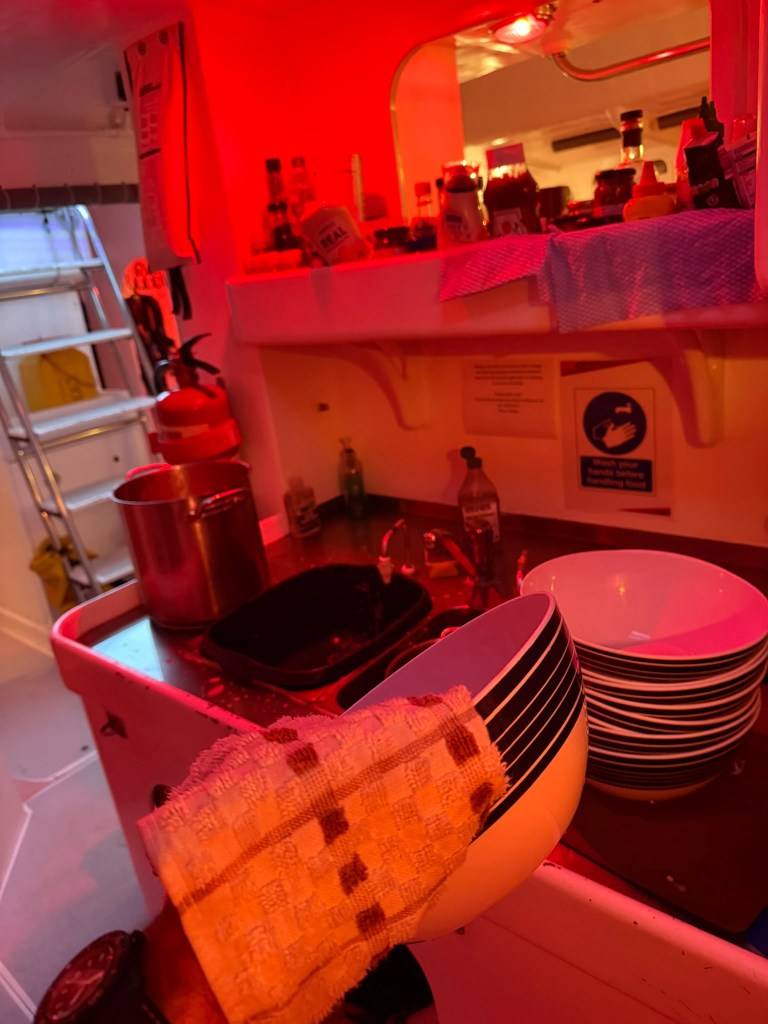
All in, we spent around 3 days out on the passage, and returned to the marina a little earlier than planned as had a blocked galley sink … note: don’t throw coffee grinds down the plug hole (or any solid food matter)
Al and Jade felt that as a crew we had adapted to the watch system well. This wouldn’t happen in the race … we’d simply have to do our own plumbing on the move!
Le Mans Start Practice
As there was another boat out on Level 2, we agreed to have a little race on our last day. This also provided an opportunity to introduce the Le Mans start.
At certain ports in the race, limited local support crew and infrastructure might mean the race starts offshore, and this is often undertaken as a Le Mans start.

A lead skipper communicates the start location, initial heading and timing, and the boats align themselves ready for the gun (so to speak).
Using an upwind course as an example, the main is out and the engine in neutral / idle (only to help keep the boats aligned) and the yankee and staysail will be on deck, hanked on, but not deployed.
A 10 minute warning allows the crew to prep in their roles, but by 4 minutes, we all need to be back behind the coffee grinder with no further prep allowed.
Prep might include knots, halyards, jammers and clutches and the “check and chuck” of the clews on the foresails to the leeward side.
Roles include:
- two sweaters for each foresail at the mast (and one, likely from the staysail team, who might need to remove sail ties) who will physically pull on the halyard to hoist the sail, until they might need to hand over to a winch / grinder
- tailers on the winches for the respective halyards.
- On the 70s the staysail will be on a pit / halyard winch, and the yankee on the primary winch
- Winch handles aren’t to be used on the primary winches due to the forces involved, so once the command to grind has been given, the tailer completes loading the winch (tailing is done with three turns initially) and hands off to the grinders
- On the 70s the staysail will be on a pit / halyard winch, and the yankee on the primary winch
- There are two coffee grinders on the 70s, which can be independent or connected, and three speed gears.
- Four people can therefore complete the yankee hoist until one of the yankee sweaters calls halyard tension on the luff
- Clear communication is required, with specificity, particularly given the staysail team will be working in parallel e.g. sweater might call “yankee halyard grind”, “yankee halyard two foot”, “yankee halyard made” etc.
- As the sails are going up, and will be under load, there is also the need for people to be on the active / working yankee and stay sail sheets to trim, grind and ease as appropriate
- Plus, of course, someone on the helm …
All in … assuming I haven’t missed something … that could be 12/13 crew members in different roles …
After the Le Mans start is completed and the sails are trimmed, the boats are usually required to hold a course for about 10 mins before conclusion.
An efficient start can have a material benefit as it can provide weather advantage and cleaner wind.
We were on 68s, but the process is basically the same, and we did two practices before the start.
Our “walkthrough” was a little over two minutes, our fast practice about 90 seconds and in the race it was just over 60 seconds … and I think the other boat may have been faster …
Jade mentioned that the fastest starts could be close to 30-40 seconds, so there is definitely still some work to do!
I’ll leave it there for Level 2. It was an excellent week with a great teaching, fun crew, some fantastic weather plus some incredible experiences – fast upwind sailing, dolphins, shooting stars, visiting birds, and my personal favourite a bright neon green meteor while helming early one morning!
Huge thanks to Al and Jade for all of the tuition and guidance, as well as insights, tips and tricks for the race itself.
Other Photos and Videos …


Enjoyed this post? Never miss out on future posts by following me!

